
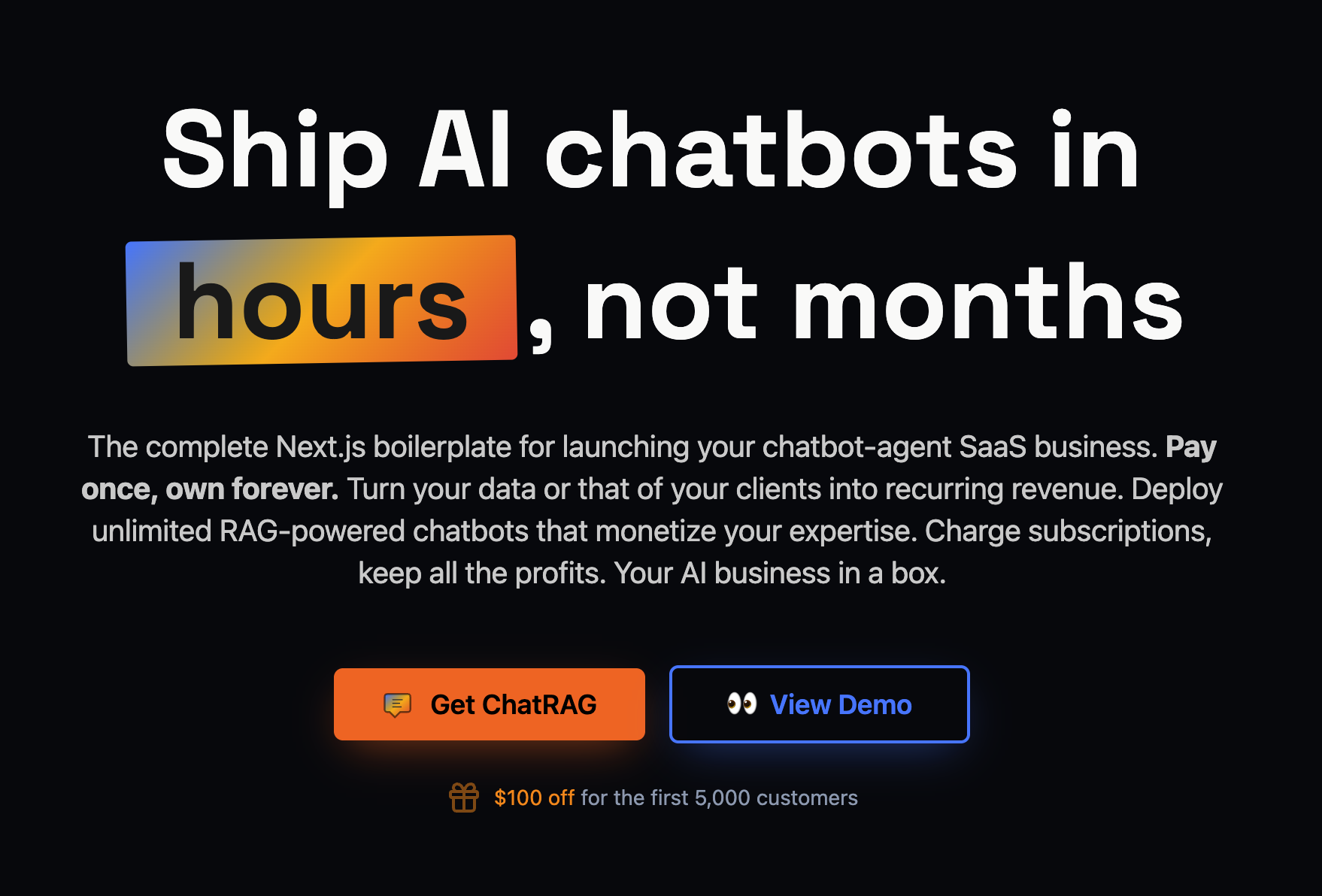
Carlos Marcial – ChatRAG Starter
$269.00 Original price was: $269.00.$35.00Current price is: $35.00.
- 24/7 Contact Support & Telegram - Ecomkevin_1
- You Can Request Any Courses
- Original Courses HD Qualite and links updated
Guaranteed Safe Checkout


Carlos Marcial – ChatRAG Starter Review: Complete Deep Dive & Practical Guide
Building production-ready AI applications requires moving beyond standard API calls to OpenAI or Anthropic. As Large Language Models (LLMs) have matured, the primary challenge for developers, prompt engineers, and tech entrepreneurs has shifted from generating text to connecting AI with proprietary, custom, or private data sources. This is where Retrieval-Augmented Generation (RAG) becomes essential.
Carlos Marcial – ChatRAG Starter addresses this specific need, positioning itself as a streamlined framework and hands-on guide designed to bridge the gap between basic LLM integration and functional, context-aware AI applications. Below is a detailed, honest review examining what the starter pack offers, how it operates, its core architecture, and whether it delivers on its promises.
What Is Carlos Marcial – ChatRAG Starter?
At its core, ChatRAG Starter is a specialized codebase, template, and instructional toolkit created by Carlos Marcial. It is engineered to help developers quickly build, customize, and deploy conversational AI agents capable of querying external knowledge bases using RAG architecture.
Instead of requiring developers to spend days setting up vector databases, configuring document loaders, tweaking chunking parameters, and managing chat histories, this starter package provides a clean, pre-structured foundation. It aims to eliminate initial setup friction, enabling users to go from a blank repository to a functional RAG-enabled chatbot in minimal time.
Understanding RAG and Why It Matters
To evaluate the value of ChatRAG Starter, it is essential to understand the problem Retrieval-Augmented Generation solves in modern AI development.
Standard LLMs suffer from two main limitations:
-
Knowledge Cutoffs: They only know information up to their training cutoff date.
-
Hallucinations: When asked about private documents, specific company policies, or niche technical data, standard models often generate plausible-sounding but completely fabricated answers.
RAG solves this by introducing an external retrieval step:
-
Ingestion: Documents (PDFs, Markdown, text, databases) are broken down into smaller chunks.
-
Embedding: These chunks are converted into numerical vector representations.
-
Storage: Vectors are stored in a vector database.
-
Retrieval: When a user asks a question, the system searches the database for the most relevant document chunks.
-
Generation: The retrieved text is passed into the LLM along with the original question, allowing the model to answer based on exact context.
The ChatRAG Starter provides a modular structure specifically tailored to handle every stage of this pipeline cleanly.
Core Features and Architecture Overview
The system design inside Carlos Marcial’s package emphasizes modularity, ease of modification, and clean separation of concerns. Rather than hiding logic behind obscure abstractions, the code remains transparent and adaptable.
1. Document Ingestion Pipeline
The starter kit includes structured scripts for loading, parsing, and preprocessing documents. It supports standard text, PDF, and Markdown formats out of the box. The parsing logic ensures that text is split efficiently using optimal chunk sizes and overlaps, which is crucial for preserving contextual continuity during vector search.
2. Flexible Vector Database Integration
Vector storage is a critical component of any RAG pipeline. ChatRAG Starter comes pre-configured with support for popular vector storage solutions, making it straightforward to connect to lightweight local vector indexes for rapid prototyping or enterprise cloud vector stores for production scaling.
3. State Management and Chat Memory
Building a functional chat interface requires keeping track of conversation context across multiple turns. The framework integrates structured chat memory systems, ensuring that follow-up questions retain context without overflowing token budgets or degrading response quality.
4. Customizable Prompt Engineering Templates
System prompts play a crucial role in directing how an AI uses retrieved context. The framework provides structured prompt templates designed to enforce strict context utilization, minimize hallucinations, and format output consistently.
5. API and UI Integration Layer
Beyond backend processing, ChatRAG Starter offers clean interface templates (typically using lightweight Python frontend frameworks like Streamlit, Chainlit, or FastUI, combined with API endpoints like FastAPI). This allows developers to test their applications visually right out of the box.
Hands-On Setup: Ease of Implementation
One of the main criteria for evaluating any development starter kit is how fast a developer can get up and running.
The workflow follows a logical sequence:
-
Environment Configuration: Setting up Python dependencies via virtual environments or containerized environments.
-
API Key Management: Simple
.envfile configuration for managing provider keys, vector store credentials, and model configurations securely. -
Data Ingestion: Dropping custom documents into a designated directory and running the ingestion script to generate embeddings.
-
Execution: Launching the local application instance to immediately test querying the custom dataset.
For developers with basic Python experience, the setup process is smooth and straightforward. The documentation provided in the repository clearly outlines each command, reducing setup errors.
Strengths and Advantages
After thoroughly analyzing the framework, several key strengths stand out:
-
Clean Code Organization: The codebase avoids overly dense abstractions. Everything is clearly separated into ingestion, retrieval, prompt formatting, and UI handling, making customization straightforward.
-
Time Savings: Setting up a robust RAG stack from scratch—handling vector embeddings, chunking strategy, conversation history, and frontend connection—can take days. ChatRAG Starter reduces this initial build time to under an hour.
-
Production-Oriented Patterns: Rather than offering a superficial demo script, the architecture uses structure that can actually be transitioned into production applications with minimal refactoring.
-
Practical Prompt Guardrails: The included system prompts are engineered to keep responses grounded strictly in the provided documents, significantly reducing hallucination rates during testing.
Limitations to Consider
While the starter framework provides an excellent foundation, a few points should be noted depending on your specific use cases:
-
Requires Basic Python Knowledge: This is not a zero-code or no-code tool. Users should be comfortable running terminal commands, managing Python environments, and editing basic configuration files.
-
Scaling Advanced Features: While the base framework handles standard RAG scenarios cleanly, complex enterprise patterns—such as hybrid search, reranking, multi-modal ingestion, or agentic query rewriting—will require additional custom engineering on top of the starter template.
-
Third-Party API Costs: Depending on the embedding models and LLMs selected, users are responsible for managing their own API usage fees with third-party providers.
Who Is This Starter Pack For?
Carlos Marcial – ChatRAG Starter is best suited for:
-
AI Engineers & Developers: Developers looking for a clean, reliable boilerplate to jumpstart client work or internal SaaS prototypes.
-
Entrepreneurs & Innovators: Founders validating RAG-based product ideas who need to build a functional Minimum Viable Product (MVP) quickly.
-
Technical Product Teams: Teams looking for a reference architecture to standardise how they ingest internal documentation for conversational search.
-
Learners and AI Enthusiasts: Individuals transitioning from simple API wrappers to real-world context-augmented AI systems.
Final Verdict
Carlos Marcial – ChatRAG Starter delivers exactly what a developer toolkit should: a clean, robust, and functional baseline that saves valuable development hours. By taking care of the tedious boilerplate code behind document processing, vector search, and conversation tracking, it allows developers to focus on what matters—customizing business logic, fine-tuning user experience, and delivering context-aware AI functionality.
If you are looking to accelerate your workflow, build reliable RAG applications, and skip the repetitive groundwork of initial setup, this starter kit is a solid and practical investment.
